

I’ve never liked the popular models of conflict.
You know the ones. The ones from the corporate trainings and the bestselling books. They tell you that when things get tense, people do one of two things: they get quiet, or they get loud. They shut down, or they blow up.
The most famous version even gives the two a name: silence, or violence. Pick your lane.
It’s a tidy little map. And, it’s also mostly blank.

Starting with the part everyone quotes: “fight or flight.” Walter Cannon identified it in 1915, watching animals under threat. For a long time, that was the whole story.
But, soon we learned that this was, in fact, not the full story. The list kept growing.
Freeze came next, when the body can’t fight or run. Then fawn, where you reduce the threat by pleasing it, making yourself agreeable and useful and small. Then a researcher named Shelley Taylor described tend-and-befriend in 2000.
She pointed out that the original fight-or-flight research had been done mostly on males. Before the mid-nineties, something like one in six stress-study subjects was female.
So, even our automatic reactions were never just two.
And those are only the reactions.
There’s a whole other set of things that happen in conflict, and they don’t live down there in the reactive space. They need you online. Regulated.
You can ask a question. You can set a boundary, or get curious, or de-escalate, or take some space, or try to build an option neither of you had thought of yet.
What’s Your Authenticity Gap?
Ever wonder how much of yourself you’re really showing? Discover the gap between your true self and your public persona. Uncover hidden costs and step into a more genuine version of you. Ready for some honest insights?
None of that is fight or flight. But, for simplicity, we can still classify the (current known) range of responses into two categories:
Reactive (automatic, nervous-system hijack, you’re out of your window of tolerance):
fight - meet the threat head-on. Anger, confrontation, pushing back, taking control. The body floods with energy to overpower what’s in front of you.
flight - get away from it. Fleeing, avoiding, leaving the room, changing the subject, staying too busy to feel it. The drive to put distance between you and the threat.
fawn - manage the threat by pleasing it. Appeasing, accommodating, over-apologizing, making yourself agreeable and useful and small so the danger lessens. Keeping the peace at the cost of yourself.
freeze - when you can’t fight or run. Stuck, blank, deer-in-headlights. Time slows, the mind goes quiet, you can’t move or decide.
flop - when freeze goes all the way. The body checks out completely. Dissociation, numbness, the body pulling the plug to protect you when nothing else worked.
tend-and-befriend - Instead of attacking the threat or escaping it, you turn toward others: protecting and caring for the people close to you (tend), and reaching for connection and support (befriend).
etc.
Responsive (regulated, deliberate, prefrontal online):
discuss - talk it through directly. Lay out what happened, what you each think, what you want, and work toward understanding. Actually having the conversation.
educate - share what information the other person doesn’t have. Explain your reasoning or the context they’re missing, without assuming bad faith. Sometimes a conflict is an information gap, rather than a clash of values.
de-escalate - lower the temperature on purpose. Slow down, soften your tone, acknowledge their feelings, take the heat out so the real issue can be worked. Not conceding.
set a boundary - What you will and won’t accept, and what you’ll do if it continues.
get curious - turn toward their reality. Ask real questions. Assume there’s something you don’t yet understand about why they’re doing what they’re doing.
repair - tend the injury. Own your part, reconnect. Conflict frays the thread between people and repair is how you mend it.
take intentional space - step back, on purpose, with a plan to return. The opposite of flight: you’re not escaping, you’re giving your nervous system time to settle so you can come back regulated. “I need an hour, let’s pick this up after dinner.”
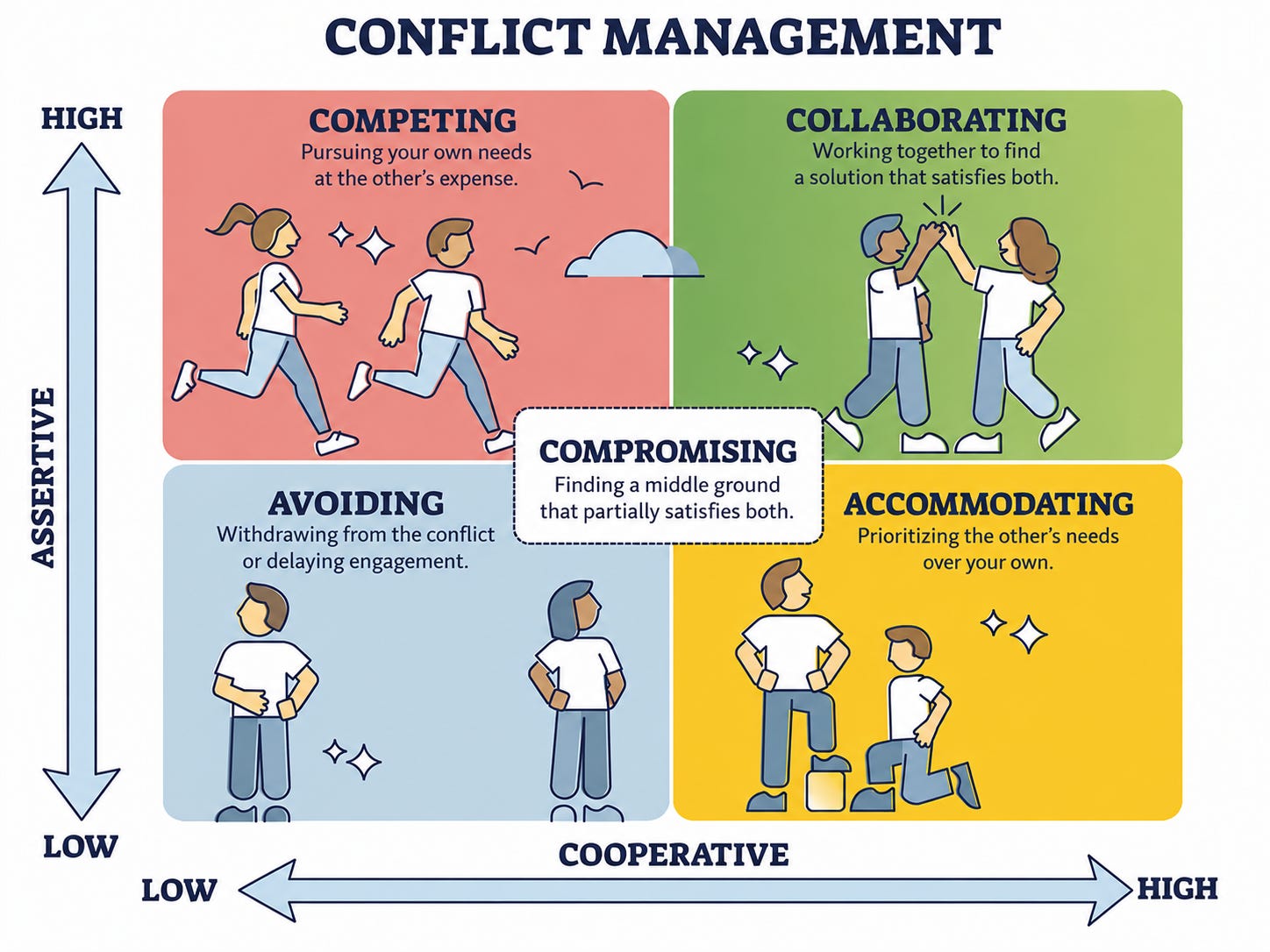
collaborate - work the problem together as a shared thing. Create something that honors both points of view, instead of one winning or both giving up. High care for yourself and for them.
etc.
The strange thing is, we’ve known this for ages.
A hundred years ago, Mary Parker Follett was writing that there are three ways through a conflict, not two. You can dominate, where one side wins. You can compromise, where everyone gives something up. Or you can integrate, where you find the thing that actually holds both.
The conflict-resolution field has had a five-option model since the seventies.
And John Gottman, who has watched more couples fight than almost anyone alive, found that most of what couples fight about never gets resolved at all. 69% of it is perpetual. You don’t solve it. You learn to live inside it.
Which means the goal was never to win the conflict, or end it. The goal is to be in conflict well.

Here’s what I’ve come to think: conflict might be the most alive place we have.
There’s a stretch of every river where it reaches the sea. The estuary. Freshwater pushing down, saltwater pushing up, the two of them arguing over the same few miles of mud.
It is the least settled water on the whole river. It is also one of the most fertile places on earth.. more life packed into it than almost anywhere, precisely because two systems are in constant conflict there. And neither one wins. The friction is the fertility.
The old models aren’t evil, they just kind of suck. They’re way too small. They took the richest and most contradictory, most alive thing we do with each other, and reduced it to silence or violence.
We contain multitudes, like the poet said. We are estuaries. The place where everything meets. The rich messy middle, the fertile mud.
FYI: I also write For People and Planet, a weekly newsletter about climate solutions and the creativity driving them. If you’re curious, you can check it out here: forpeopleandpla.net
Further reading:


For more like this, follow me wherever you connect with friends:
Bluesky 💖 LinkedIn 💖 Mastodon 💖 X 💖 Instagram 💖 TikTok 💖 Threads 💖 YouTube 💖 Facebook
With love, Bri Chapman
This is groundbreaking. WOW!!!!!!